# 엔비디아, 데이터센터 전력 800볼트 직류로 바꾼다…랙 한 줄에 2MW [컴퓨팅](https://zdnet.co.kr/news/?lstcode=0020&page=1) 입력 :2026/08/13 14:39 [**AI 에디터 **](https://zdnet.co.kr/reporter/?lstcode=media) 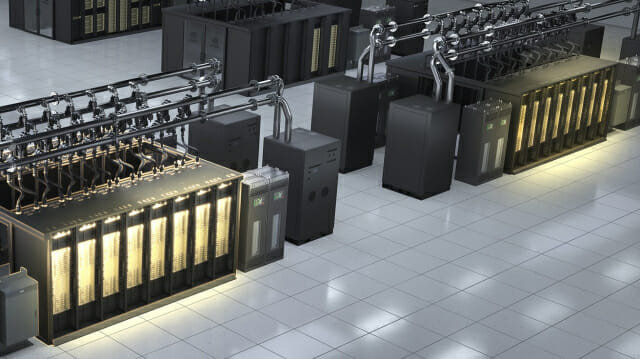  엔비디아가 데이터센터 내부 배전을 800볼트 직류(800VDC)로 전환하는 설계를 공개했다. 엔비디아 블로그에 현지 시각 8월 11일 게시됐다. 기존 데이터센터는 교류 전력을 받아 여러 단계를 거쳐 전압을 낮춘 뒤 서버에 공...
The Shift to 800V DC
Nvidia has unveiled a groundbreaking architectural shift for data center power distribution, transitioning to an 800-volt direct current (800VDC) system. Announced on August 11, 2026, this new design aims to overcome the severe limitations of traditional alternating current (AC) systems, which require multiple inefficient voltage step-down stages before reaching the server rack. By adopting 800VDC directly from the grid or local microgrids, Nvidia significantly reduces power conversion losses, minimizes heat generation, and improves overall energy efficiency across the facility.
Meeting the Extreme Demands of AI
This radical transition is primarily driven by the exponential power requirements of modern AI accelerators and large language model training clusters. Under the new architecture, a single high-density GPU rack can now safely support up to 2 megawatts (MW) of continuous power. This represents a massive leap from traditional 10-20 kilowatt racks.
- Eliminates multiple AC-to-DC conversion stages, boosting end-to-end efficiency.
- Reduces heavy copper cabling requirements and lowers cooling overhead.
- Enables unprecedented compute density and performance per square foot.
Industry Impact and Future Outlook
Nvidia's bold move sets a new industry standard for AI data centers, forcing a paradigm shift in electrical engineering and facility design. Major hyperscalers and cloud providers are expected to rapidly adopt similar high-voltage DC architectures to scale their AI infrastructure sustainably. Looking ahead, the widespread deployment of 800VDC ecosystems will likely spur rapid innovations in advanced power electronics, direct-to-chip liquid cooling integration, and grid-scale renewable energy storage. Ultimately, this transition paves the way for the next generation of gigawatt-scale AI supercomputers, ensuring that power delivery is no longer the bottleneck for artificial intelligence advancement.